
Frequently asked questions about vaping in everyday life – charging, indoor use and regulations
There are several everyday questions that often arise about vaping. Many people wonder whether you can charge a vape overnight, whether it is permitted to use a vape indoors and what applies if you live in an apartment.
The answers depend partly on the type of vape involved, where it is used and which rules apply in the particular environment. It is also important to distinguish between technical safety, legislation and consideration for other people.
In this guide, we go through common questions about charging, indoor use and vaping in an apartment. The aim is to provide a clear and practical overview of what may be worth considering in everyday life.
Can you charge a vape overnight?
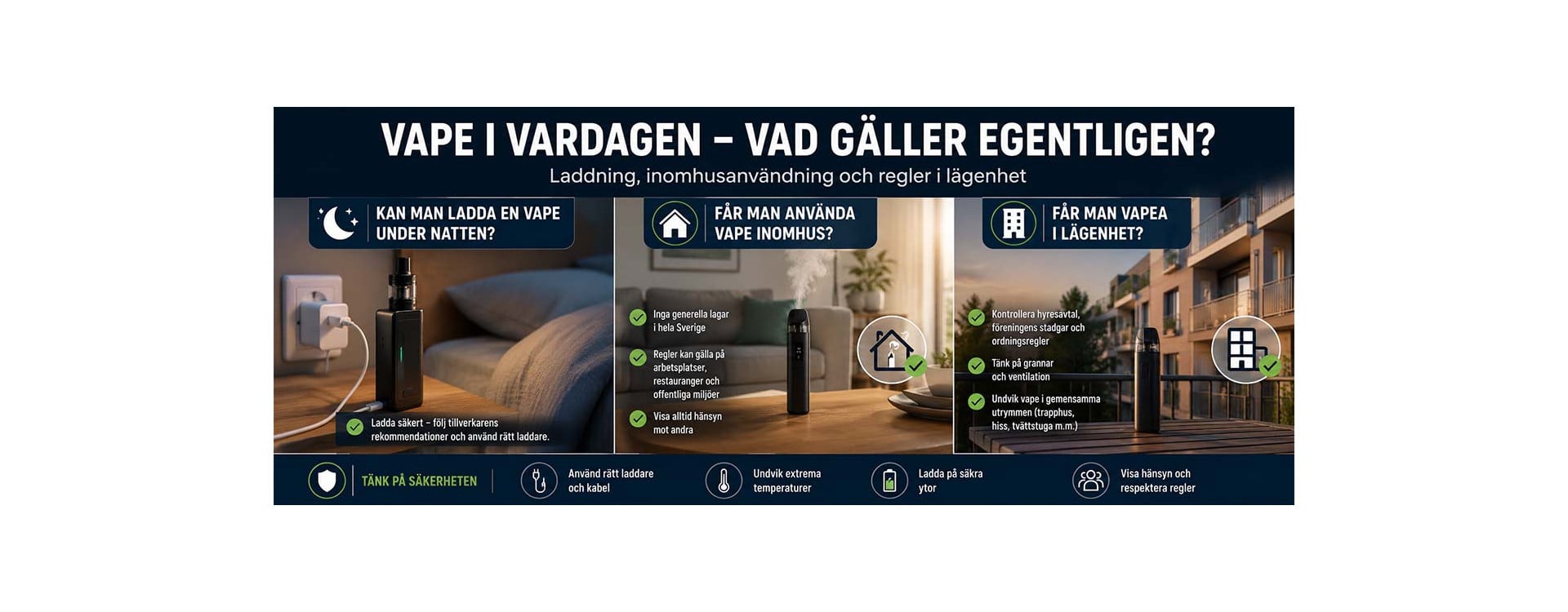
It is technically possible to charge many vape devices overnight, but from a safety and battery perspective, it is not always the most recommended approach. A vape usually contains a lithium-ion battery, and such batteries are affected by charging habits, heat and wear over time.
Many modern vape devices have protective circuits designed to limit charging when the battery is full. This reduces the risk of classic overcharging, but it does not mean that charging routines are unimportant.
If a vape is left plugged in for a long time, the battery and charging circuit may still be exposed to unnecessary heat and strain. It is therefore often better to charge the device when you can monitor it and unplug it when it is fully charged.
What should you consider when charging a vape?
When charging, it is important to follow the manufacturer's instructions for the specific product. Different devices may have different requirements for cables, chargers and current.
Some general things to consider when charging include:
- Use a cable and charger that are suitable for the device
- Charge on a stable, heat-resistant surface
- Avoid charging in bed, on the sofa or under textiles
- Unplug the device when the battery is fully charged
- Do not charge a device that is unusually hot or damaged
- Avoid damaged cables and loose connections
- Always follow the product manual or the manufacturer's recommendations
If you want to read more about batteries, heat, cold and overcharging, you can read our guide Common problems with vape batteries.
Is it dangerous to charge a vape overnight?
It cannot be said that all overnight charging is automatically dangerous, but it does mean that the device is often left unattended for a long time. If there is a problem with the cable, charger, battery or charging port, it may be noticed later than if the device is charged while someone is awake.
A vape that becomes very hot, charges unusually slowly, smells strange or shows signs of damage should not be charged further until the cause has been checked.
To reduce unnecessary risks, it is better to:
- Charge before going to bed
- Unplug the device when it is fully charged
- Avoid charging near flammable materials
- Do not use unknown or damaged chargers
- Keep the device on a stable surface while charging
Are you allowed to use a vape indoors?
Whether you are allowed to use a vape indoors depends on where you are. A private home normally has different conditions than, for example, a workplace, shop, restaurant, school, public transport or other public environment.
Vaping is not always subject to exactly the same rules as smoking in every situation, but many businesses and property owners have their own rules that prohibit or restrict the use of vapes indoors.
This means that it is not enough to consider only what the law says. You also need to take local rules of conduct, workplace regulations, tenancy conditions, association rules and other people in the same environment into account.
Where are you usually not allowed to use a vape indoors?
Many places have rules that restrict or prohibit vaping indoors, although the rules may be worded in different ways. This may apply, for example, to environments where smoking and similar use are not permitted.
Examples of places where vaping is often prohibited or restricted include:
- Workplaces
- Shops and shopping centres
- Restaurants and cafés
- Schools and educational environments
- Public transport
- Hotel rooms where the rules prohibit use
- Common areas in buildings
- Event venues and arenas
The safest approach is always to check which rules apply at the particular location and ask staff or the person responsible if you are unsure.
Are you allowed to vape in an apartment?
If you live in your own apartment, the rules may depend on whether it is a rental apartment, a condominium or another type of housing. There may also be rules of conduct from the landlord, condominium association or property owner.
In many cases, the issue is not only the use itself, but also consideration for neighbours and common areas. Even though vaping does not work in the same way as smoking tobacco, smells, vapour and use near ventilation systems or balconies may affect other people.
If you live in a rental apartment, you should check what is stated in the tenancy agreement and which rules of conduct apply. If you live in a condominium, the association's bylaws and house rules may be relevant.
Can a landlord or condominium association have rules about vaping?
Yes, a landlord, condominium association or property owner may have rules of conduct that restrict the use of vapes in certain environments. This applies particularly to common areas such as stairwells, laundry rooms, basements, storage areas, lifts and entrances.
In some cases, the rules may also apply to balconies or other areas where use may affect neighbours. It is therefore important to read the rules that apply to your particular home.
If a neighbour experiences disturbances from smells or vapour, it may become a matter of consideration and the living environment, even if there is no specific rule that explicitly mentions vaping.
Can vaping affect neighbours?
Vaping produces vapour from e-liquid rather than tobacco smoke, but the vapour can still have a smell. The smell may be perceived differently depending on the flavour profile, ventilation and how close other people are.
In an apartment, vapour and smells may sometimes spread through open windows, balconies or ventilation systems. It may therefore be wise to consider where and how the product is used, especially in apartment buildings.
To show consideration, it may be helpful to:
- Avoid using vapes in common areas
- Be considerate of neighbours on balconies or patios
- Air out the room if necessary
- Avoid blowing vapour towards ventilation systems or open windows
- Respect the association's or landlord's rules
Can a fire alarm react to vape vapour?
In some cases, vapour from a vape can affect sensitive fire alarms or detectors, especially if the vapour is blown directly towards the alarm or if the room is small and poorly ventilated.
The risk varies depending on the type of detector, the amount of vapour and the environment. Some fire alarms react more easily to particles or vapour in the air than others.
In hotels, workplaces, schools and other environments with sensitive alarm systems, you should therefore be especially careful and follow the rules in place.
What should you consider if you use a vape at home?
When using a vape at home, it is good to consider safety, ventilation and storage. A vape should be stored in a way that reduces the risk of damage, especially if there are children or pets in the home.
Some practical things to consider include:
- Keep vapes and e-liquid out of the reach of children
- Store products in a cool place protected from direct sunlight
- Do not charge the device on soft or flammable surfaces
- Check that the pod, tank and battery are intact
- Do not use a damaged device
- Follow the manufacturer's instructions
- Be considerate of other people in the home
If you want to compare different types of models, our range of vapes is collected in the vapes and e-cigarettes category.
What applies to vaping in common areas?
Common areas in a building are often covered by rules of conduct. This may include stairwells, lifts, laundry rooms, storage areas, garages and entrances.
Even if there is no specific sign about vaping, you should assume that using a vape in common areas may be inappropriate if it disturbs other residents.
The best approach is to follow the building's rules and avoid using a vape where other people may be affected.
Frequently asked questions about vaping in everyday life
Can you charge a vape overnight?
It is possible with many devices, but it is better to charge while monitoring the device and unplug it when the battery is full. Use the correct charger and avoid damaged cables.
Are you allowed to use a vape indoors?
It depends on the location. In private homes, the rules may differ from those at workplaces, restaurants, hotels, schools and in common areas, where specific rules often apply.
Are you allowed to vape in an apartment?
It may depend on the type of housing, tenancy agreement, association rules and consideration for neighbours. Always check which rules apply in your home.
Can neighbours complain about vaping?
Yes, if smells or vapour are perceived as disturbing, it may become a matter of consideration and the living environment, especially in apartment buildings.
Can vaping set off a fire alarm?
In some environments, vapour can affect sensitive fire alarms, especially if the vapour is blown directly towards the detector or if ventilation is limited.
Things to remember
Questions about vaping in everyday life often concern technology, rules and consideration. Charging a vape overnight is not always the best choice, even though many modern devices have protective circuits. It is better to charge while monitoring the device and unplug it when it is fully charged.
Whether a vape may be used indoors depends on the location and the rules that apply there. In an apartment, you should also consider the tenancy agreement, association rules, ventilation and neighbours.
By following the manufacturer's instructions, checking local rules and showing consideration for others, you can reduce the risk of problems in everyday life.