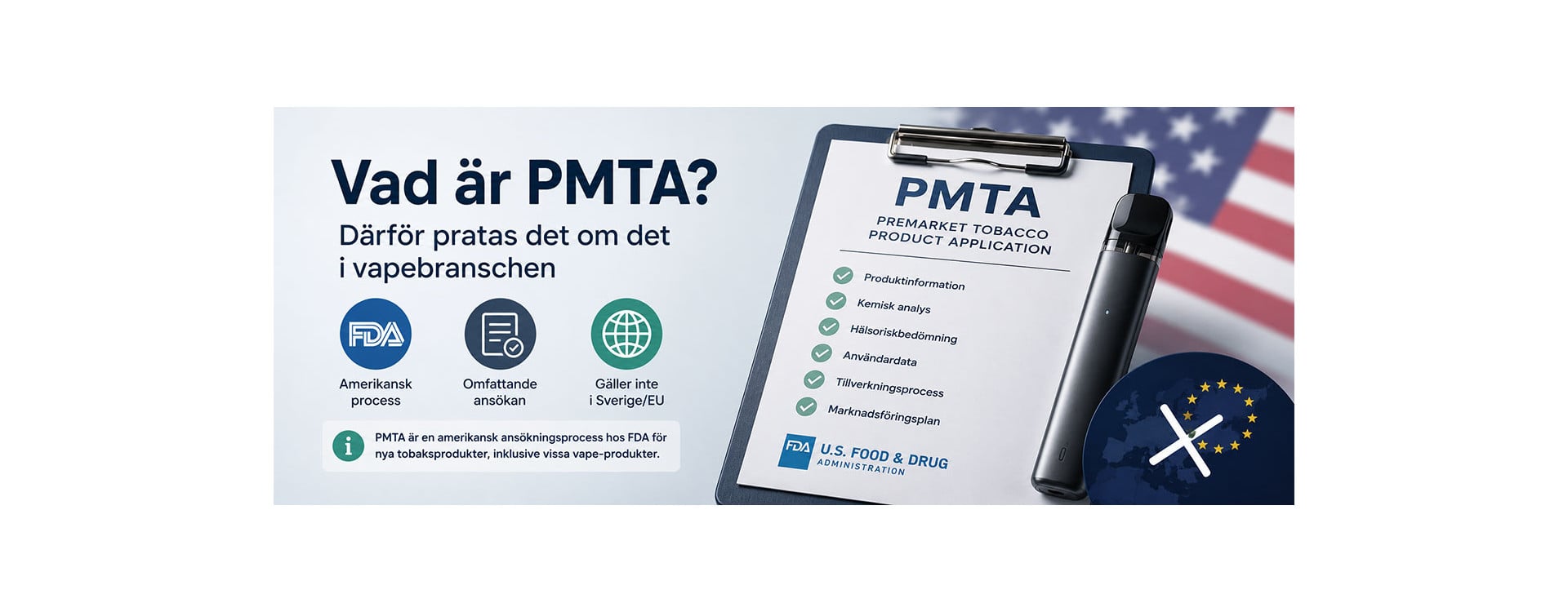
What is PMTA and why is it discussed in the vape industry?
PMTA is an American application process for new tobacco products, including certain vape products and e-cigarettes. The term often appears on international manufacturers’ websites and in industry news. If you are considering buying a vape in Sweden, it is good to know that PMTA only applies to the American market and not to the regulations governing which products may be sold in Sweden and the EU.
In this guide, we explain what PMTA means, why it is important in the USA and what you should know when comparing different vape products on the Swedish market.
What does PMTA mean?
PMTA stands for Premarket Tobacco Product Application. It is an application that manufacturers may need to submit to the American authority FDA (Food and Drug Administration) before a new tobacco product may be marketed and sold on the American market.
The process applies not only to traditional tobacco products, but may also include electronic cigarettes, pod systems, disposable vapes and other nicotine products that are regulated as tobacco products in the USA.
A PMTA may include very extensive documentation. Among other things, the manufacturer needs to provide details about the product’s contents, manufacturing process, laboratory tests and scientific documentation, which the FDA uses in its assessment.
Why does PMTA exist and what is its purpose?
The purpose of PMTA is to enable the FDA to review new tobacco products before they may be sold in the USA. The manufacturer needs to submit extensive documentation about the product, including information about its contents, manufacturing, use, risk assessment and how the product may affect public health.
The FDA’s assessment does not concern whether a product is risk-free. It concerns whether the product meets the requirements for being marketed on the American market under US legislation.
Why is PMTA discussed in the vape industry?
PMTA has become a common term in the vape industry because the USA is a major market for e-cigarettes and vape products. Many international brands are therefore affected by the FDA’s decisions, even if the products are also sold or discussed in other parts of the world.
When the FDA decides that a product may be marketed in the USA, a so-called Marketing Granted Order (MGO) is issued. This means that the product may be sold on the American market according to the conditions covered by the decision. If an application is denied, however, the product may not be sold there legally.
That is why PMTA is often mentioned in industry news, particularly in connection with larger manufacturers, pod systems, disposable vapes and flavoured vape products.
Does PMTA mean that a vape is safe?
No. PMTA does not mean that a vape product is safe or risk-free. The assessment is a regulatory decision by the FDA and should not be interpreted as a general safety certification.
It is also important to distinguish between regulatory decisions and the product’s actual use. A product may have been reviewed under a regulatory framework without this meaning that the product is free from risks or that the same decision applies in other markets.
Does PMTA apply in Sweden?
No. PMTA does not apply in Sweden, but is linked to the American market and the FDA’s regulatory framework.
In Sweden and the EU, different rules apply to e-cigarettes, vape juice and vape products, including through the EU Tobacco Products Directive (TPD) and Swedish legislation.
This means that a product may be relevant in a PMTA context in the USA, but still need to meet entirely different requirements to be sold in Sweden or within the EU.
If you are going to buy a vape in Sweden, it is therefore more important to choose products adapted for the European market and compliant with the regulations that apply here than to focus on whether the product has a PMTA-related status in the USA.
If you would like to read more about the rules that apply to vape products within the EU, you can read our guide What is the TPD law and how does it affect vapers in the EU?. There, we go through the most important rules governing the sale of vape products within the EU.
What is the difference between PMTA and TPD?
PMTA and TPD are sometimes confused, but they are not the same thing. PMTA belongs to the USA and is handled by the FDA, while TPD is the EU’s Tobacco Products Directive and forms the basis for many of the rules that apply to e-cigarettes and e-liquids within the EU.
- PMTA is the FDA’s American review process.
- TPD is the EU’s regulatory framework for, among other things, e-cigarettes and e-liquids.
- Sweden applies TPD together with national regulations.
For Swedish consumers, it is therefore more important to understand the EU and Swedish regulations than to look solely at PMTA status. These are the rules that determine which products may be sold on the Swedish market.
Why do some manufacturers mention PMTA?
Some manufacturers highlight PMTA because the American market is important to their business. This may mean, for example, that a product has been submitted for review, that the manufacturer is awaiting a decision or that the FDA has made a decision about the product.
For a Swedish customer, however, this does not automatically mean that the product complies with the rules applicable to sales in Sweden or the EU. When comparing different products, it is therefore a good idea to focus on models intended for the European market.
Common misconceptions about PMTA
- PMTA does not apply worldwide. It is an American regulatory framework and does not automatically apply in Sweden or the EU.
- PMTA does not mean that a product is risk-free. It is a regulatory assessment, not a general safety guarantee.
- PMTA is not the same as TPD. PMTA applies to the USA, while TPD applies within the EU.
- A PMTA product is not automatically approved for sale in Sweden. Products must still meet Swedish and European requirements.
Why is it useful to know about PMTA?
For those who buy vapes in Sweden, PMTA is primarily a term that helps you understand international news and information from manufacturers. When choosing a product, however, the Swedish and European regulations are the most relevant, as these determine which products may be sold on the Swedish market.
PMTA is therefore most useful as background knowledge. It helps you interpret information from the American market, but should not be confused with the requirements that apply to products sold in Sweden.
FAQ about PMTA
Do all vape products have a PMTA?
No. Many vape products are never sold on the American market and are therefore not covered by the PMTA process. PMTA is primarily relevant to products intended to be marketed and sold in the USA.
Why don’t all manufacturers apply for PMTA?
A PMTA application is often both extensive and resource-intensive. The manufacturer needs to prepare technical documentation, laboratory tests and scientific evidence that the FDA uses in its assessment. For companies that do not sell products in the USA, there is therefore often no reason to carry out the process.
What happens if a PMTA is denied?
If the FDA denies a PMTA, the product may normally not be legally marketed or sold on the American market. Such a decision does not automatically affect whether the product may be sold in Sweden or other EU countries, since different regulations apply there.
How much does a PMTA application cost?
The total cost varies depending on the product and how extensive the documentation that needs to be prepared is. In addition to any authority fees, there are often costs for laboratory tests, scientific analyses and regulatory work, which means that the process can become expensive.
Does PMTA also apply to nicotine-free vape products?
It depends on how the product is classified under American legislation. PMTA covers tobacco products regulated by the FDA, but whether or not a nicotine-free product is covered is determined by the American regulations applicable to the specific product type.