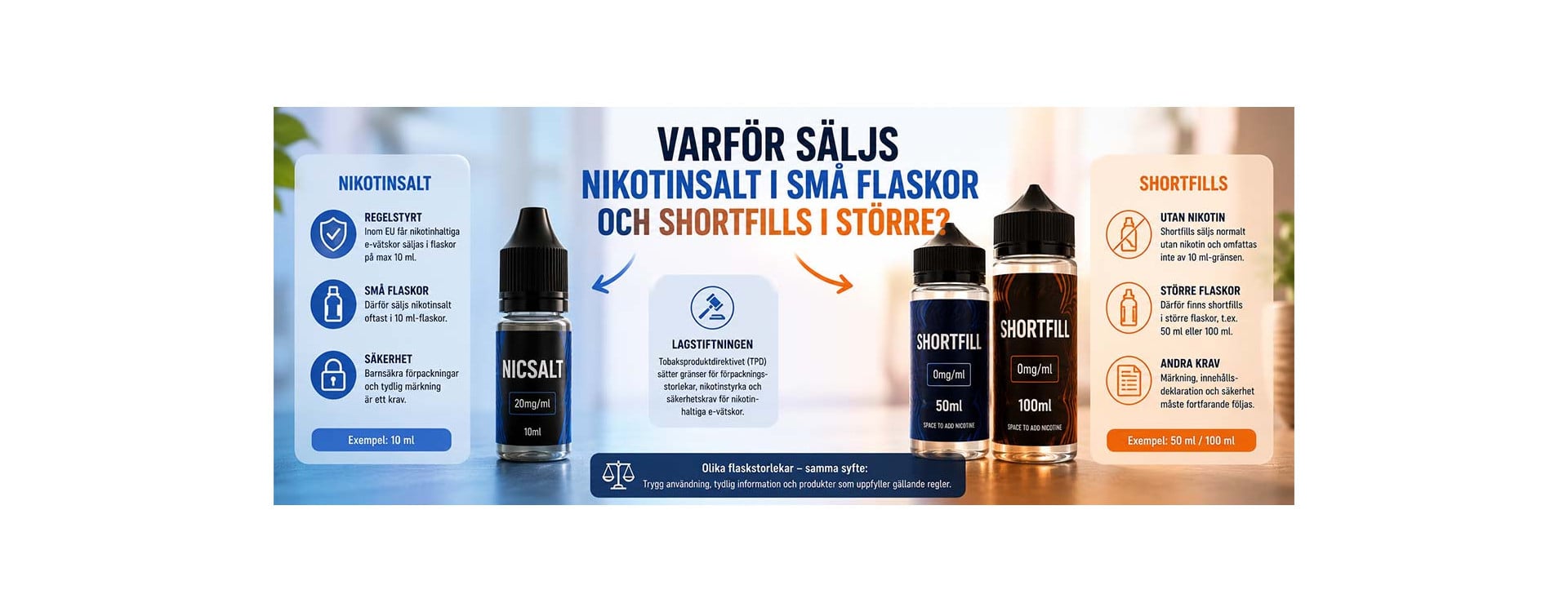
Why are nicotine salts sold in small bottles and shortfills in larger ones?
If you have compared different types of e-liquids, you have probably noticed that nicotine salts are almost always sold in small bottles, while shortfills are often available in significantly larger packages. Many people believe this is down to the manufacturers’ choices or marketing, but the most important explanation is actually legislation.
In this article, we explain why bottle sizes differ, what distinguishes nicotine salts from shortfills, and which regulations affect how the products may be sold.
If you want to read more about different types of vape juice, you can find our range here.
The short answer
Nicotine salts are usually sold in small bottles because nicotine-containing e-liquids within the EU are subject to specific regulations that limit the size of refill containers. Shortfills, on the other hand, are normally sold without nicotine and are therefore not subject to the same restrictions.
That is why it is common to see nic salts in 10 ml bottles, while shortfills are often sold in significantly larger packages.
What are nicotine salts?
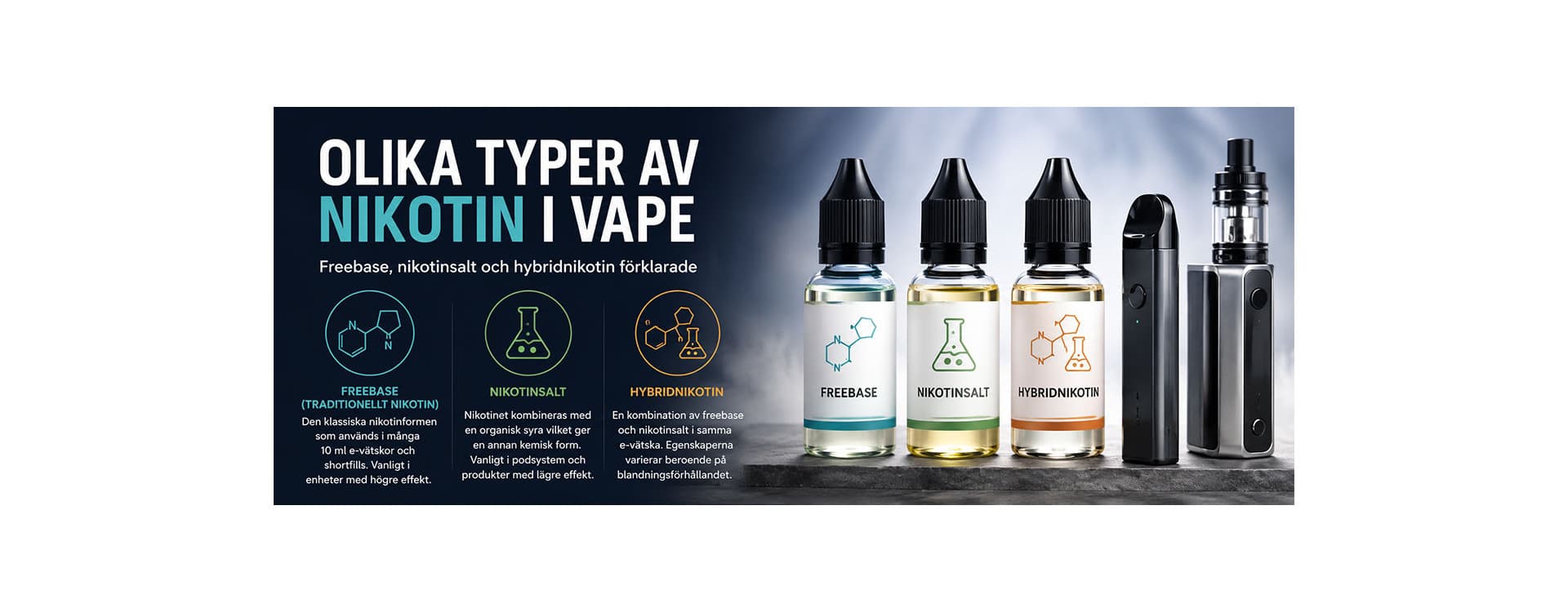
Nicotine salt is a type of e-liquid that contains nicotine in a chemical form that differs from traditional freebase nicotine. These products are often used in pod systems and other devices designed for lower power.
If you want to read more about different products in the nic salt category, you can find our range here.
Because nicotine salts contain nicotine, these products are subject to specific regulations for nicotine-containing e-liquids.
Why are nicotine salts often sold in 10 ml bottles?
The main reason is European legislation. Within the EU, nicotine-containing e-liquids are regulated by the Tobacco Products Directive (TPD), which includes requirements regarding bottle size, labelling and safety features.
For nicotine-containing refill containers, the bottle generally may not be larger than 10 ml. That is why the majority of nicotine salt products are sold in precisely this size.
The regulations also include requirements for child-resistant packaging, safety labelling and product information.
What are shortfills?
Shortfills are e-liquids that are normally sold without nicotine. The bottle is not filled all the way to the top, leaving space inside the container.
Shortfills are commonly sold in larger bottles than traditional nicotine-containing e-liquids. They are available in several different sizes depending on the manufacturer and product.
If you want to read more about different shortfills, you can find our range here.
Why are shortfills sold in larger bottles?
Because shortfills normally do not contain nicotine when sold, they are not subject to the same 10 ml restriction as nicotine-containing e-liquids.
This allows manufacturers to offer larger bottle sizes. That is why it is common for shortfills to be sold in, for example, 50 ml, 100 ml or other larger formats.
Although shortfills are not subject to the same size restriction, they must still meet other requirements regarding labelling, ingredient declarations and product safety.
What do the regulations say?
The regulations surrounding e-liquids vary between different markets, but within the EU there are common requirements for nicotine-containing products.
The purpose of the regulations is, among other things, to establish clear safety requirements, standardised labelling and restrictions for certain types of products.
That is why you often see the same bottle sizes from many different manufacturers, even when the products come from different brands.
Why do many people think it is about marketing?
Many users assume that bottle size is purely a business decision made by the manufacturer. In practice, however, it is often the regulations that determine which sizes may be used for different types of products.
This does not mean that all products look exactly the same, but it explains why nicotine salts are almost always sold in smaller bottles than shortfills.
What should you keep in mind?
When comparing different e-liquids, it is important to understand that the bottle size does not necessarily say anything about the product’s quality or intended use.
- Always read the product information.
- Check whether the product contains nicotine.
- Follow the manufacturer’s instructions.
- Keep e-liquids out of reach of children and pets.
- Check that the packaging is undamaged before use.
By understanding why bottle sizes differ, it becomes easier to interpret the product range and understand how different categories are regulated.
The most important thing to remember
Nicotine salts are usually sold in 10 ml bottles because nicotine-containing e-liquids are subject to specific regulations that limit the size of refill containers.
Shortfills are normally sold without nicotine and are therefore not subject to the same restriction. This is the main reason why shortfills are often available in significantly larger bottles.
The difference is therefore primarily about regulations and product category, not about manufacturers choosing different bottle sizes for marketing reasons.
Contains nicotine, which is a highly addictive substance. Age limit: 18 years.