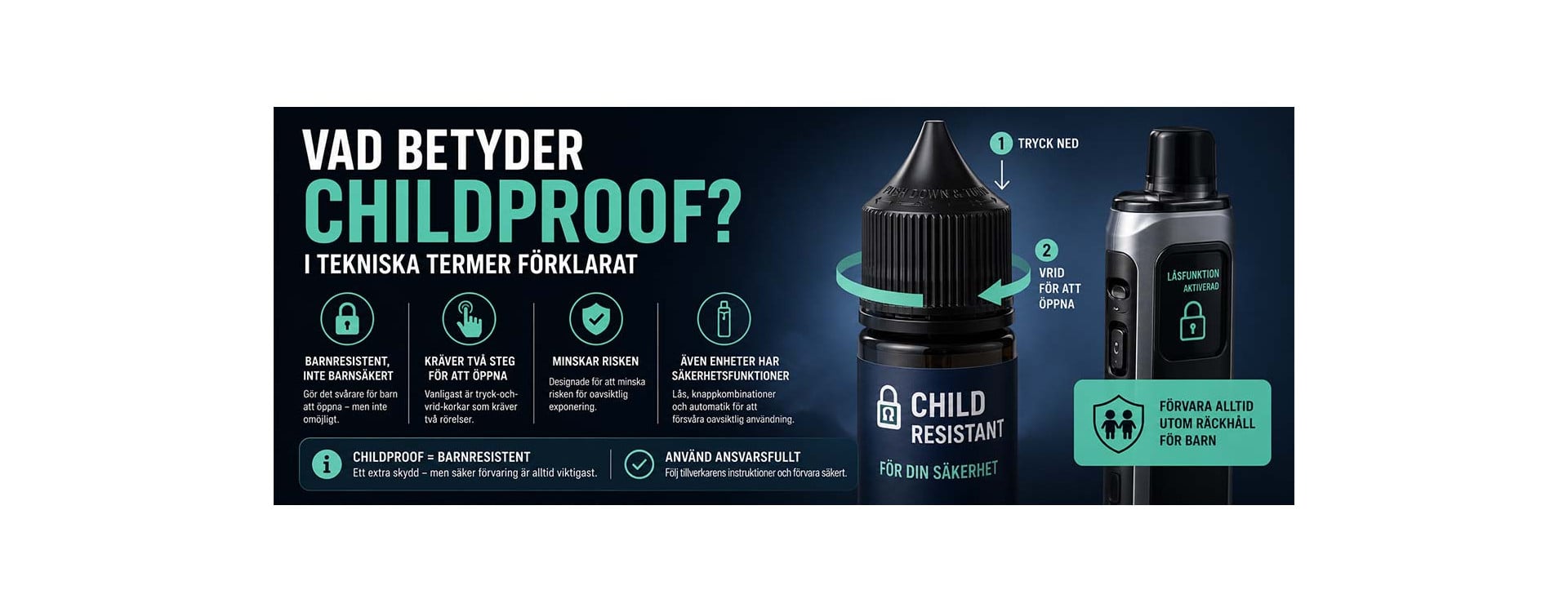
What does childproof mean in technical terms?
The term "childproof" often appears on packaging for e-liquids, nicotine products, medicines and other products that may pose risks if handled by children. Although the word is often translated as child-safe, it does not mean that the product is impossible for a child to open. In technical and regulatory contexts, childproof instead refers to making the product more difficult for children to access.
In this article, we explain what childproof means, how the technology works and why it is used on many products within the vaping and nicotine segments.
If you would like to read more about different types of vape, you can find our range here.
What does childproof mean?
Childproof is an English expression used to describe products or packaging designed to reduce the risk of children opening or using them on their own.
The more technically accurate term is often "child-resistant", which means resistant to children. The purpose is to make access more difficult for young children while still allowing adults to use the product.
This means that a childproof feature does not guarantee that a child can never open the product. Instead, it is intended to make this significantly more difficult and reduce the risk of accidental exposure.
Why are childproof features used?
Products containing nicotine, medicines, chemicals or other substances that may be unsuitable for children are often subject to requirements for child-resistant packaging.
Within vaping, childproof solutions are used, among other things, on bottles of vape juice, nicotine products and certain types of refill systems.
The purpose is to reduce the risk of children accessing the contents without adult supervision.
How do childproof caps work?
The most common type of childproof solution is the classic push-and-turn cap. Opening the packaging requires two movements at the same time:
- Press down the cap.
- Turn the cap in the correct direction.
Young children often have more difficulty understanding or performing both actions at the same time, which makes the packaging harder to open.
Other solutions may use locking mechanisms, sliding mechanisms or specific combinations of movements required to access the contents.
Which products use childproof protection?
Child-resistant solutions are used across many different product categories.
- E-liquids and nicotine products.
- Medicines.
- Cleaning products.
- Chemicals.
- Certain battery-powered products.
- Refill containers.
Within vaping, childproof features are particularly common on bottles of e-liquid and products containing nicotine, including certain types of nicsalt.
Can vape devices have child-resistant features?
Yes, some vape devices are equipped with features that can make it more difficult for children to use the product. Examples may include locking functions, button combinations for activation or automatic safety systems that limit accidental use.
Some devices, for example, may need to be unlocked using a specific button sequence before they can be used. Other models may have features that automatically switch off the device when it has not been used for an extended period.
However, it is important to distinguish between child-resistant packaging and safety features in the device itself. Even if a vape has built-in protective features, it should always be stored out of the reach of children.
A safety feature is a complement to responsible storage and should not be regarded as a guarantee that a child cannot use the product.
Is childproof the same as child-safe?
No. This is one of the most common misconceptions.
When manufacturers use the term childproof, they normally mean that the product is child-resistant. This means that the product is designed to be more difficult for children to open or use, but not that it is completely safe to leave unattended.
Therefore, products containing nicotine, chemicals or other potentially harmful substances should always be stored out of the reach of children, even if they have childproof features.
What limitations does childproof design have?
No child-resistant design is completely foolproof. Children develop different skills at different ages, and some children may manage to open products that others cannot.
A childproof solution may also work less effectively if the packaging is damaged, worn or used incorrectly.
It is therefore important not to view childproof protection as a replacement for safe storage.
What do legislation and standards say?
Many markets have specific requirements for child-resistant packaging for products containing nicotine or other substances that may pose risks in the event of accidental exposure.
Manufacturers must therefore often demonstrate that their packaging meets relevant standards and safety requirements before the products can be sold.
The requirements may vary between countries and product categories, but the goal is the same: to reduce the risk of children accessing the contents.
What should you consider as a user?
Even if a product has childproof features, it should always be handled responsibly.
- Store nicotine products out of the reach of children.
- Never leave opened products unattended.
- Check that caps and lids are properly closed.
- Replace damaged or worn packaging.
- Follow the manufacturer's instructions for storage and use.
Childproof technology provides additional protection, but it does not replace safe handling and storage.
The most important thing to remember
Childproof usually means that a product is child-resistant, not that it is completely child-safe. The technology is used to make it more difficult for children to open or use products containing, for example, nicotine or other substances that should be handled with care.
Both child-resistant packaging and safety features in certain vape devices are designed to reduce the risk of accidental use, but they do not replace responsible storage.
Products with childproof features should always be stored safely and out of the reach of children. Safe storage remains the most important protective measure.
Contains nicotine, a highly addictive substance. Age limit 18 years.