
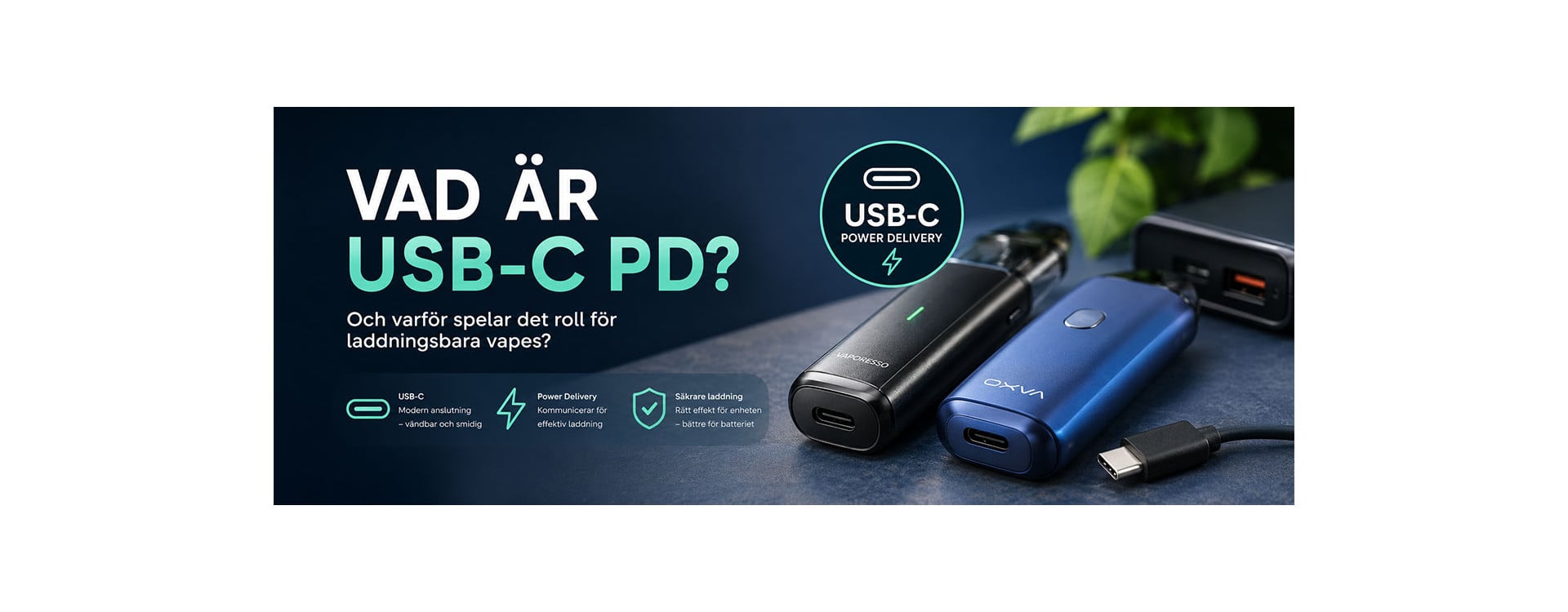
USB-C PD is a charging standard that can enable compatible devices to charge more efficiently by allowing the charger and device to communicate with each other. USB-C is used in many modern pod systems and vape kits, but it is important to distinguish between standard USB-C charging and USB-C Power Delivery, often abbreviated to USB-C PD.
For those comparing different rechargeable vapes, the charging port, battery capacity and recommended charging current can be important specifications to consider. They affect how the device charges, which charger should be used and how smoothly the product works in everyday use.
Short answer: what is USB-C PD?
USB-C is the connector and charging port itself. USB-C PD, or USB-C Power Delivery, is a charging protocol that allows the charger and device to negotiate the correct voltage and current. It is often used in mobile phones, tablets, laptops and certain modern electronic products with rechargeable batteries.
However, not all products with USB-C have USB-C PD. A vape can therefore have a USB-C port without supporting PD fast charging.
What is USB-C on a vape?
USB-C is the charging connector that has become common on many modern electronic devices. On a vape, the USB-C port is used to charge the built-in battery. For the user, this often means a more practical charging solution than older connectors, since the USB-C cable is reversible and fits either way.
USB-C is now common on modern pod systems and rechargeable vape kits. However, this does not automatically mean that the device can charge as quickly as possible. Charging is still controlled by the product's battery, electronics and the specifications provided by the manufacturer.
What does USB-C Power Delivery mean?
USB-C Power Delivery, often called USB-C PD, is a technology in which the charger and device communicate to determine the appropriate charging level. Instead of a charger simply delivering a fixed level, a PD-compatible device can request a level that suits its battery and charging circuit.
This is particularly important for products where the battery needs to be charged efficiently but in a controlled manner. A larger device, such as a laptop, may need considerably more power than a small vape. Therefore, USB-C PD does not mean that all products charge at the same power level, but that charging can be adapted to what the device supports.
The difference between USB-C and USB-C PD
It is easy to confuse USB-C and USB-C PD, but they do not mean the same thing.
- USB-C describes the connector or port used for charging.
- USB-C PD describes a charging protocol that can handle higher and more tailored power levels.
- A vape with USB-C does not automatically support USB-C PD.
- A vape with USB-C PD needs to be designed to support this type of charging.
The most important thing is therefore to read the product specifications. If it only says USB-C, this normally means that the product charges via a USB-C port. If it says USB-C PD, Power Delivery or, for example, lists several charging levels such as 5V/3A and 9V/2A, this may indicate support for more advanced charging.
Why does USB-C PD matter for vape batteries?
Vape batteries are sensitive components that should be charged according to the manufacturer's recommendations. This is why charging technology is important. A well-designed vape uses charging circuits that regulate how the battery is charged and when charging should be limited or stopped.
USB-C PD can be relevant because the technology is based on communication between the charger and the device. This means that a compatible device can request a charging level it is designed to handle. However, if a vape does not support PD, it will normally charge according to its own limitations, even if you use a more powerful USB-C charger.
For the user, the practical point is simple: use the correct cable, a reputable charger and always follow the charging information on the product page or in the manual.
Can you use any USB-C charger with a vape?
No, it is not always a good idea to use just any charger. Even if the connector fits, the charger should be of good quality and suitable for the product's recommended charging level. A powerful USB-C charger for a laptop is not automatically unsuitable, but it is the product's own charging circuit and specifications that determine how charging is handled.
If the manufacturer specifies, for example, 5V/1A or 5V/2A, you should use that as your guide. Do not use damaged cables, loose connections or chargers of unknown origin. This is particularly important for smaller devices with built-in batteries.
If you are considering charging your vape while travelling, you can also read our guide Can you use a power bank to charge your vape?, where we explain what you should consider when using an external battery bank.
Does a vape charge faster simply because it has USB-C?
Not necessarily. USB-C can provide greater ease of use, but charging speed depends on several factors:
- battery capacity
- the device's charging circuit
- recommended charging current
- whether the product supports fast charging or USB-C PD
- which charger and cable are used
A small pod device with USB-C may therefore charge more slowly than a larger vape with a more advanced charging circuit. This does not mean that anything is wrong; it means that the products are designed for different battery sizes and uses.
How can you tell if a vape has USB-C or USB-C PD?
The best way is to check the specifications. A product page may, for example, state:
- Charging: USB-C
- Charging current: 5V/1A or 5V/2A
- Fast charging: USB-C PD
- Input: 5V/3A, 9V/2A or similar
If it only says USB-C, you should not assume that the product has USB-C PD. In that case, it is safer to describe it as a vape with USB-C charging.
Vape kits at Cigge with USB-C charging
Several modern vape kits and pod systems at Cigge use USB-C for charging. This makes them practical for those who want a rechargeable vape with a modern connection. The exact charging standard, battery capacity and recommended charger may differ between models, so always check the specifications on the respective product page.
Examples of products in our range where USB-C charging is relevant to check:
- OXVA NEXLIM Pod Vape Kit – pod system from OXVA with a modern design and rechargeable battery.
- OXVA Xlim GO 2 Pod Vape Kit – compact pod system for those comparing rechargeable vape kits.
- OXVA NEXLIM GO Pod Vape Kit – rechargeable pod device in OXVA's NEXLIM series.
- Vaporesso Vibe SE Pod Vape Kit – pod system from Vaporesso focused on ease of use and a rechargeable design.
- Vaporesso Vibe Pod Vape Kit – rechargeable vape kit in the Vaporesso Vibe series.
- Vaporesso VIBE Nano Pro Pod Kit – compact pod system with a clear product display and modern charging solution.
- Vaporesso ECO Nano Plus Vape Kit – rechargeable vape kit in the ECO Nano series.
- Vaporesso Vibe Nano Pod Kit – pod system from Vaporesso in a smaller format.
You can find more models in the vape starter kits category. If you want to compare brands, you can also view the range from OXVA and Vaporesso.
If USB-C charging is an important feature for you, it may be a good idea to compare battery capacity, charging specifications and compatible pods before choosing a model. Information about charging and technical specifications can be found on the respective product page.
USB-C on a vape compared with a disposable vape
USB-C is primarily relevant for rechargeable vape products. Some disposable vapes may also have a charging port, but the purpose is normally to ensure that the battery lasts for the e-liquid already contained in the device. A rechargeable pod or vape kit, on the other hand, is designed for repeated charging and longer use with replaceable pods, coils or cartridges, depending on the model.
If charging and battery life are important factors when choosing a product, a rechargeable vape kit is often more relevant to compare than a disposable device.
Common mistakes when charging a vape
- Assuming that USB-C always means fast charging. USB-C is the port, not automatically fast charging.
- Using damaged cables. A damaged cable can result in a poor connection and should be replaced.
- Using unknown chargers. Use chargers of good quality and follow the product's recommendations.
- Ignoring the product specifications. Charging current and battery capacity can vary significantly between different models.
- Charging in hot or damp environments. Always charge in a stable location and according to the manufacturer's instructions.
Is USB-C PD always better?
Not always. USB-C PD can be an advantage for products designed for it, particularly if the device has a larger battery and supports higher charging power. However, PD may not be necessary for small pod systems. Stable and correctly limited USB-C charging may be fully sufficient.
The most important thing is therefore not that the product has the highest possible charging power, but that charging is adapted to the device's battery and electronics.
What should you look for before choosing a vape with USB-C?
If charging is an important part of your decision, you can compare the following specifications:
- Battery capacity: often stated in mAh and affects how long the device can be used between charges.
- Charging port: USB-C is common on modern models.
- Charging current: for example, 5V/1A or 5V/2A.
- Fast charging: check whether the product explicitly states USB-C PD or another type of fast charging.
- Pod or coil type: affects how the product is used and maintained.
- Compatibility: check which pods, coils or cartridges fit the device.
For many users, USB-C is a practical advantage, but it should be considered together with battery life, pod system, compatibility and how the product is intended to be used.
FAQ about USB-C PD and vapes
Can I use a USB-C PD charger even if my vape does not support PD?
In many cases, yes. A USB-C PD charger can normally deliver standard USB power to devices that do not support Power Delivery. The most important thing is to follow the manufacturer's recommendations and use a charger of good quality.
Do all vapes with USB-C support USB-C PD?
No. USB-C describes the charging connector itself, while USB-C PD is a separate charging standard. A vape can therefore have a USB-C port without supporting Power Delivery.
Does the USB-C cable matter?
Yes. A damaged or low-quality USB-C cable can affect charging. For the best results, use an intact, good-quality cable intended for charging and follow the manufacturer's recommendations.
Does USB-C PD shorten battery life?
Not necessarily. Battery life is affected by several factors, including the battery's construction, temperature, charging circuit and how the product is used. If a vape supports USB-C PD, the charging process is designed to work together with the device's electronics.
Is USB-C PD important on small pod systems?
Not always. Many smaller pod systems charge efficiently using standard USB-C. If a device supports USB-C PD, it is an additional feature, but that does not automatically mean it is better suited than other models. Battery capacity, compatible pods and other specifications are also important to compare.