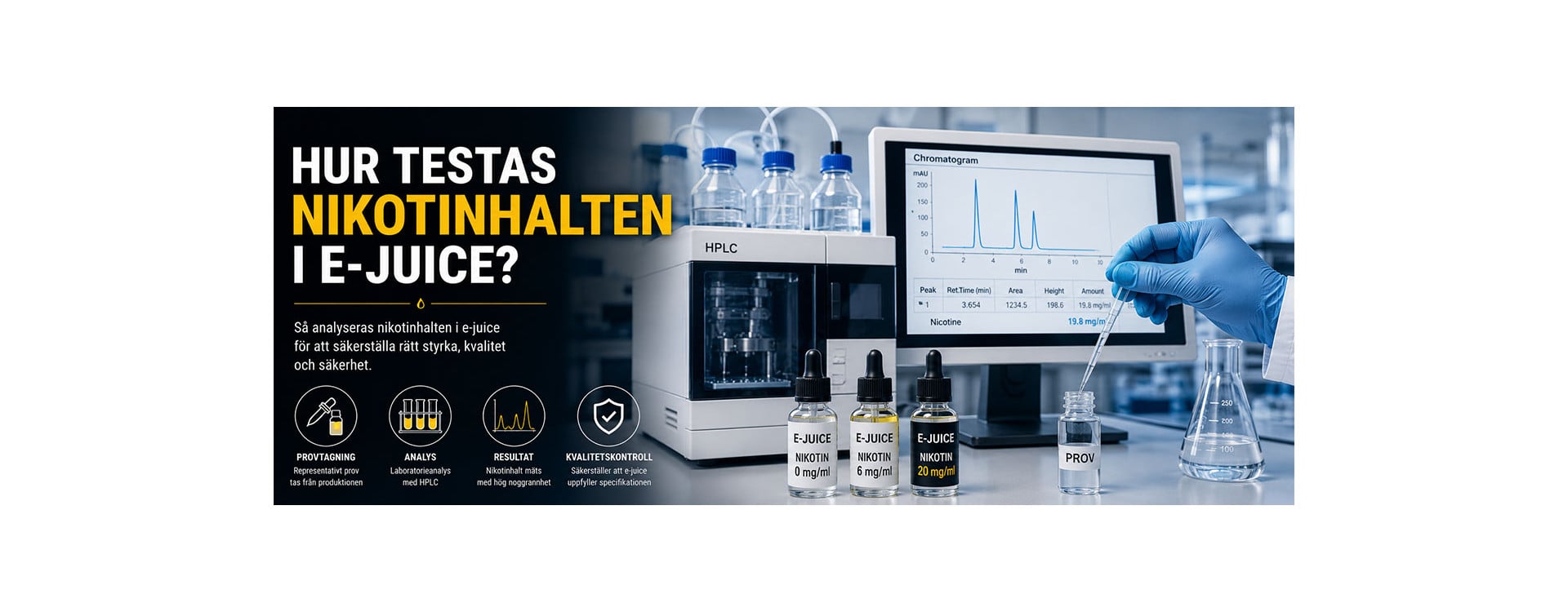
Nicotine content is one of the most important characteristics of an e-juice. For a product to correspond to its stated strength, the manufacturer needs to ensure that the nicotine content falls within the limits applicable to the product. This is done through laboratory testing and quality controls during manufacturing.
In this article, we explain how the nicotine content in e-juice is usually tested, which analytical methods are used, and why quality control is an important part of the manufacturing process.
Why is the nicotine content tested?
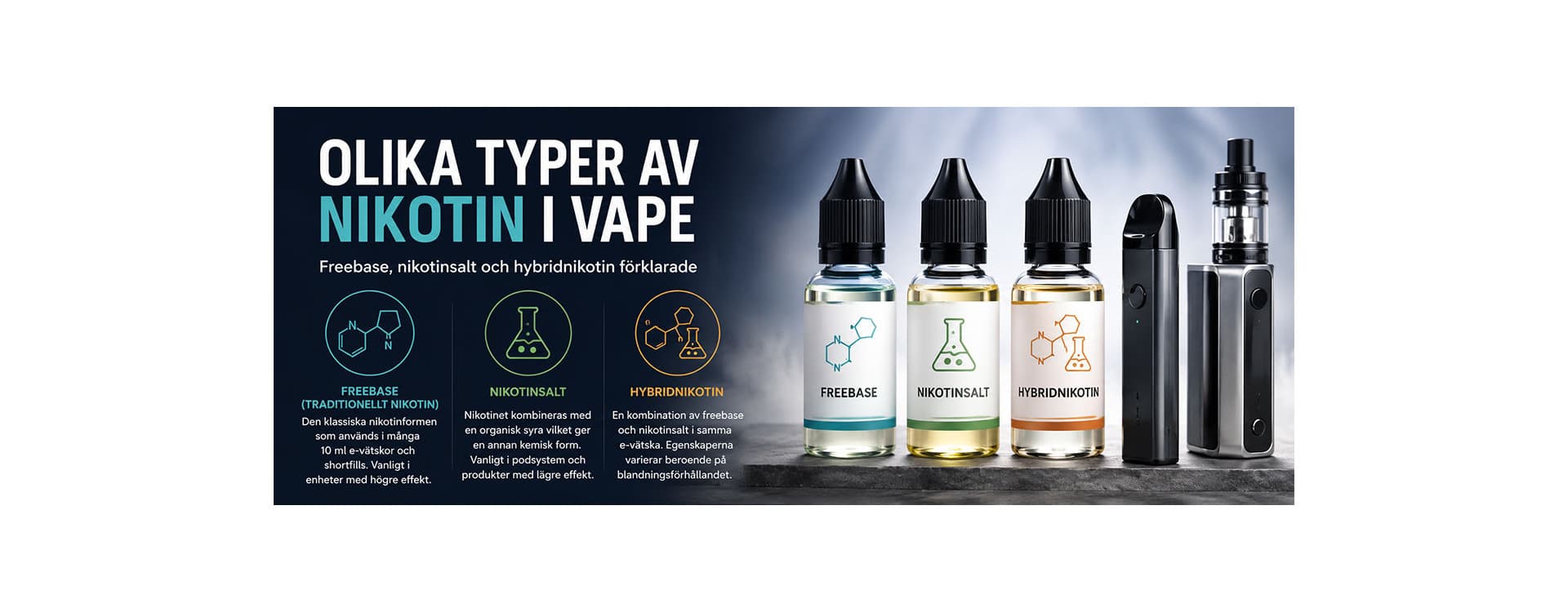
Nicotine content is usually stated in milligrams per millilitre (mg/ml). For example, an e-juice labelled 20 mg/ml contains 20 milligrams of nicotine per millilitre.
To ensure that the declared strength is accurate, the manufacturer needs to verify that the mixture contains the correct amount of nicotine before the product is sold.
Laboratory testing is therefore used to verify that the nicotine content corresponds to the product specification.
When during manufacturing are tests carried out?
Manufacturers may carry out quality controls at several stages of production.
- Inspection of incoming raw materials.
- Sampling during the mixing process.
- Analysis of finished e-juice.
- Random sampling of finished, packaged products.
Which controls are carried out and how often they are performed varies between different manufacturers and production facilities.
How is the nicotine content measured?
Nicotine content is not normally analysed using simple rapid tests. Instead, laboratories use instruments that can measure very small concentrations with a high degree of accuracy.
One of the most common methods is liquid chromatography (HPLC, High Performance Liquid Chromatography). The method is used in many areas where chemical substances need to be identified and quantified.
During the analysis, a sample of the e-liquid is diluted and passed through the analytical instrument. The instrument separates the different substances and measures how much nicotine the sample contains.
Why is HPLC used?
HPLC is used because the method can provide accurate and reproducible measurement results, even at low concentrations.
The analysis can, among other things, be used to:
- Verify the nicotine content.
- Compare different production batches.
- Check that the product meets the manufacturer's specifications.
- Document quality controls.
Similar analytical techniques are also used in the pharmaceutical, food and chemical industries.
How is a sample taken?
For laboratory analysis, a representative sample is normally taken from the finished e-juice. The sample is diluted according to the laboratory's analytical method and then analysed in the instrument.
To ensure reliable results, reference solutions with known nicotine concentrations are often used. The instrument is calibrated against these before the samples are analysed.
Can the nicotine content vary between different batches?
In industrial manufacturing, the aim is to maintain a consistent nicotine content between different production batches. Quality controls and laboratory analyses are therefore used as part of the manufacturing process.
Minor variations may occur, but established manufacturers normally use processes designed to produce a consistent composition from batch to batch.
How does mixing affect the result?
For the nicotine content to be uniform, the nicotine needs to be thoroughly mixed with the other ingredients, such as propylene glycol (PG), vegetable glycerin (VG) and flavourings.
Modern production facilities use mixing equipment designed to produce a homogeneous mixture before the product is filled into bottles or pods.
If you would like to read more about the composition of e-juice, you can read our article on VG and PG ratios.
Are other properties also tested?
Yes. In addition to the nicotine content, manufacturers may also analyse other properties depending on the product and quality programme.
Examples include:
- The homogeneity of the liquid.
- The purity of the ingredients.
- Microbiological analyses.
- Stability over time.
- Filling volume checks.
Which analyses are carried out varies between different manufacturers.
How is nicotine content regulated in Sweden?
E-cigarettes and nicotine-containing e-liquids sold on the Swedish market are subject to provisions based on the EU Tobacco Products Directive (TPD).
Among other things, there are rules regarding the maximum nicotine content allowed in nicotine-containing e-liquids sold to consumers. The products must also be notified before they are placed on the market.
You can read more about the regulations at the Public Health Agency of Sweden.
Things to remember
The nicotine content in e-juice is usually checked through laboratory analyses in which production samples are analysed using instruments capable of measuring the nicotine concentration with a high degree of accuracy. The purpose is to ensure that the product corresponds to the declared nicotine strength and the manufacturer's specifications.
Quality controls may be carried out both during production and on finished products, and often include more analyses than just the nicotine content.
Quick facts
- Nicotine content is stated in mg/ml.
- Laboratory analyses are used to verify the nicotine content.
- HPLC is a commonly used analytical technique.
- Sampling may take place both during and after production.
- Quality controls often include several analyses in addition to the nicotine content.
- Regulations for nicotine-containing e-liquids are based on the EU Tobacco Products Directive.